Tuesday, June 11, 2013

Parties Respond to Central Hudson/Fortis Revisions to Merger Proposal and Rate Plan Extension

With the time for a PSC decision on the Fortis proposal for takeover of Central Hudson approaching, and facing a Recommended Decision of DPS Administrative Law Judges urging disapproval, Central Hudson and Fortis filed a revised proposal with dubious "enhancements."  See After Final Submissions on Prior Proposal, Fortis, Central Hudson File New Plan With PSC for Fortis Acquisition, May 30, 2013.

Parties have filed responses to the revisions.  PULP maintains that continuing the rate plan is actually more of a benefit to the utilities, and not customers, because it allows an excessive return on equity (ROE) of ten per cent at a time when the PSC is allowing less.  Earlier this year, the PSC allowed a 9.3% ROE in the Niagara Mohawk d/b/a National Grid rate case, and DPS staff has testified in support of an 8.7%S ROE in the pending Con Edison case.  Also, the Central Hudson/Fortis proposal continues "single issue" ratemaking, where an item of cost that may go up (storm damage cost) is allowed to be "deferred" for future collection from customers, while other items of cost, such as interest on debt may go down and the utility is allowed to keep the benefit of that cost reduction.  Normally, as a narrow exception to the general rule against retroactive rate making and the filed rate principle, "deferral" of unexpected costs during a rate plan are disfavored, and are not allowed to be recovered later if the utility is overearning or would overearn if customers paid the deferred cost.

PULP demonstrated in its Response to Petitioners' May 30 letter to Commissioners and in an attachment to them that Central Hudson's ROE for the past three years has been well over what would be allowed now if there were full review of the rates, which would be in the range of 9%.
PULP’s analysis, based on Central Hudson’s filings with the Securities and Exchange Commission (SEC), finds that Central Hudson’s earnings have generally been well above 9.3% over the course of the current Central Hudson rate plan.  These SEC filings, which can be used to calculate ROEs on a trailing four quarter basis that generally agree with DPS regulatory calculations to within +/- 30 basis points, show that during the implementation period of the Company's current rate plan to date (the eleven quarters from July 1, 2010 through March 31, 2013), Central Hudson’s four quarter trailing ROE has exceeded 10% six times.  Four of these times the Company achieved an ROE at-or-above the 10.5% threshold for sharing.  
Thus, PULP argues, extending the flawed rate plan beyond its term is not in the interest of customers.  PULP pointed out that there is no evidence in the form of testimony to support the reasonableness of a 10% ROE for Central Hudson after its rate plan expires at the end of this month, because there were no evidentiary hearings in the case.

PULP also cited the pending National Fuel Gas Distribution Company (NFG) case in which the Commission is considering temporary rates and lowering rates due to that company's apparent excessive earnings.  In that case, DPS staff is seeking a 9% ROE. Also, Multiple Intervenors, representing large business customers,  is urging even lower rates for NFG and an end to mounting deferrals of single item costs that have risen whose recovery from customers would increase over earnings. Inexplicably, Multiple Intervenors filed a letter supporting further extension of Central Hudson's rate plan with a 10% retrurn and additional deferral liability for customers - rate flaws it objected to in the NFG case.

Citizens for Local Power filed extensive documentation of financial risks from the takeover, widespread community and local government opposition to the merger, and supplemental information regarding Fortis operations elsewhere, in further opposition to the merger.  Robert F. Kennedy, Jr. also filed a letter in opposition based on Fortis' environmental record in Belize, and an additional letter was submitted by Assemblyman Kevin A. Cahill, who asked the Commission not to rule on the matter until a Commission vacancy is filled by a newly appointed Commissioner.

The case is on the PSC Agenda for June 13, 2013.

Monday, June 10, 2013

PULP Files Testimony in Con Edison Rate Case, Seeking Improved Low Income Rates, Reduced Service Interruption to Collect Bills, Improved Storm Cost Recovery Measures

Con Edison filed new rates in January 2013 which were suspended by the Public Service Commission for an 11-month review and likely modification.  Con Edison requested an electric rate increase of approximately $375 million and updated the request in March to $411.9 million.  The total "delivery rate" increase requested is about 7.9%.  (Con Edison sometimes describes the increase as lower, based on total bills which include the estimated cost of "supply" service, which is handled separately for rate purposes.)

On May 31, 2013, PULP filed testimony of expert witness Nancy Brockway in the pending Con Edison rate cases.  PULP is seeking improved low income rates, reduced use of service interruption as a bill collection measure, and improvement in allocation of risks and incentives in storm outages and storm cost recovery. Referencing an AARP report, The Quiet Storm, the testimony makes the point that for many customers, Con Edison bills are not affordable, and that each month more than 200,000 households are threatened with interruption of service due to unpaid bills.  PULP proposes improved coverage of low income rates to reach more low income customers, and reform of collection practices to move toward reduced reliance on interruption of service. PULP urges review of low income customer participation and benefits from existing utility ratepayer funded energy efficiency programs, and reforms necessary to assure a fair measure of participation and direct benefits for low-income customers.  PULP urges review and reform of the "Revenue Decoupling Mechanism" which, ceteris paribus, gives Con Edison the same revenue through upwarsd rate adjustments when service is interrupted and no electricity is delivered, for example, during storm outages or during periods when service is deliberately interrupted for collection purposes.  PULP also seeks reforms to decrease ratepayer subsidy of ESCO services and improved information for customers considering ESCO service, or who for any reason, want to know what Con Edison would charge for a specific amount of service during a particular time period.

Department of Public Service (DPS) Staff and other intervenors also filed testimony, which is available at the PSC website page for Case 13-E-0030 et al.

Notably, DPS Staff recommended electric and gas  rate decreases, as opposed to the increases requested by Con Edison.  The largest proposed DPS Staff adjustment to the Con Edison request is a return on equity (ROE) of 8.7%, in contrast to Con Edison's request for an ROE of 10.35.  The Department of State's utility Intervention Unit proposed a lower ROE, and improved low income rates.

Rebuttal testimony is due June 21, and hearings are currently scheduled to begin July 22.

////////////////////////////////

Follow PULP on Twitter


Thursday, May 30, 2013

After Final Submissions on Prior Proposal, Fortis, Central Hudson File New Plan With PSC for Fortis Acquisition

"The game's isn't over until it's over."

After more than a year of proceedings involving the proposed acquisition of Central Hudson by Fortis, Inc., after months of review of a contested Joint Proposal put forward by some parties, after a Recommended Decision of two Administrative Law Judges that the PSC reject the proposal, and after final submissions of parties opposing and supporting the proposal were made to the PSC, in a last-minute stratagem, on May 30, 2013, Central Hudson and Fortis filed a letter to PSC Commissioners containing a new proposal.

The Central Hudson Press Release touts the new offer in the latest gambit, direct bargaining with the Commission, as containing "enhancements" to the joint proposal that was previously litigated without hearings.  Last minute changes proposed in the plan include continuation of the current multi-year rate plan adopted in 2010, which otherwise expires June 30, 2013, through July 1, 2015, capital investment of $215 million, hiring of additional employees,  a four-year no layoff provision, and other "enhancements".

While parties have not had an opportunity to fully assess the proposal, the "sweeteners" touted by Central Hudson's latest filing may not be so sweet for customers. For example, added capital investment means that in the future customers will pay for it and will pay the utility a return on its investment, so without careful scrutiny, simply pouring more money into the utility is a recipe for future rates that will be higher than otherwise.  See Canadian customers assail Fortis rate hikes.

With borrowing costs low, and low inflation, it may be that Central Hudson's rates deserve a trimming, not a "freeze" at what may be an excessive level. Continuing the generous 2010 rate plan that allows the company to earn 10.5% - and even more after sharing part of the excess above 10.5% with customers -- by extending the plan to July 1 2015 may be more of an "enhancement" to Fortis' earnings than to customer benefits.

Under the current rate plan, Central Hudson appears to be earning more than the returns on equity (ROE) allowed by the PSC in recent cases, which have been in the low to mid-9% range.  Based on Central Hudson's financial reports filed with the SEC, the trailing four quarters' earnings as of June 30, 2012 -- the end of the second Rate Year in the current rate plan -- were 10.5%, just at the 10.5% threshold at which Central Hudson's would begin to be shared with customers, and at September 30, 2012 they were at 10.7%.  While the periods covered in the SEC reports may be slightly different from Rate Year, and the books of account kept for PSC regulatory purposes may differ from the SEC filing data, and the earnings have dipped since September 2012, earnings of this magnitude nonetheless raise questions about the advisability of approving the acquisition and extending the rate plan without a fuller record, evidentiary hearings and full rate review.

What is the "enhancement" to customer benefits in extending a rate plan that would just enshrine for another year an earnings sharing mechanism that begins at 10.5%?. The PSC has not been so generous in its ROE and sharing decisions in more recent rate cases.

For example, in the 2013 PSC Order in the recent Niagara Mohawk case,  50/50 sharing of earnings with customers begins at 9.3%, with no "deadband" in which the company keeps earnings above the intended ROE.  Also, in the June 2011 PSC Order setting Orange and Rockland rates, ROE was set at between 9.4 and 9.6% over the three years, with 50/50 sharing of earnings with customers beginning at 10.2%.

Other flaws in the current rate plan, such as the lack of any curb on the tactic of service interruption to collect overdue bills, and the shifting of storm outage risks and costs to customers, make its further extension a dubious "benefit".

Finally, even if a modified extension of the rate plan were a good deal in the short run, it does not outweigh the long term risks of this holding company's proposed acquisition of the local utility.


*****************


Robert F. Kennedy Jr. to NYPSC: Don't Approve Fortis Inc.'s Proposed Acquisition of Central Hudson

In a letter filed May 29, 2013 with the New York Public Service Commission, Robert F. Kennedy Jr. has asked the Commission to follow the recommendation of two Administrative Law Judges and disapprove the proposed acquisition of Central Hudson Gas and Electric Co. by Fortis, Inc., a Canadian holding company.  Citing Fortis' conduct in Belize, he stated:
My own experience with Fortis, Inc., has shown Fortis to be a corporation that pursues growth and expansion at the expense of, and with breathtaking disregard for, the people its utilities were created to serve.
Further, he questioned the future financial stability of Fortis:
There are other reasons why the PSC should be extremely skeptical about Fortis's capacity and appropriateness to be the owner of a New York State utility. Some of these are financial. Fortis may have begun as a hydroelectric company in Newfoundland, but it has long since become a holding company whose principal interests and motivations are financial. Its success is predicated on continuous expansion, with all the risks that inevitably accompany such a stragegy. The acquisition of Central Hudson, for $1.5 billion, including $500,000,000 in outstanding debt, financed by a $600,000,000 subscription, and producing almost $500,000,000 in goodwill, which cannot be used to raise rates, will place significant additional financial pressure on the company—pressure that will have to be relieved either by cutting costs, or by further expansionary tactics and new acquisitions, all of which will tend to reduce Fortis' already weak capacity to add anything, either financially or managerially, to the responsible evolution and strengthening of Central Hudson.
Mr. Kennedy's letter is available in the Public Comment section of the PSC case file in Case 12-M-0192


*****************


Thursday, May 23, 2013

PULP Urges PSC to Follow Recommendation of Administrative Law Judges to Reject Fortis, Inc.'s Proposed Acquisition of Central Hudson Electric & Gas


The Public Utility Law Project of New York, Inc. (PULP), along with numerous community  groups, opposes the proposed acquisition of Central Hudson by Fortis, Inc. and supports the ultimate conclusion of the Recommended Decision handed down by Administrative Law Judges (ALJs) Epstein and Prestemon on May 3, 2013, which advises the Public Service Commission to reject a “Joint Proposal” of some of the parties to the case who agreed to settle the merger case without full litigation.

While fully supporting the conclusion of the judges in their Recommended Decision, PULP  filed a brief with the PSC raising addition concerns on May 17th, 2013.  These include the following points:

• THE PSC “STAKEHOLDER” PROCESS DID NOT YIELD A CREDIBLE SETTLEMENT BECAUSE IT LACKED AN INDEPENDENT RESIDENTIAL RATEPAYER ADVOCATE

The Public Service Commission prefers settlement of major cases instead of litigation, and under its Settlement Guidelines it ordinarily will defer to the results of a confidential negotiation process supported by a broad group of active parties in a case who represent diverse and normally adverse interests.  Although their decision ultimately disapproved the merger, the ALJs found that the Joint Proposal for merger is broadly supported. PULP contends the settlement process which culminated in the Joint Proposal lacks participation and support of any independent advocate on behalf of residential customers.  The Department of State's Utility Intervention Unit (“UIU”) supports the merger but it lacks the indicia of an independent advocate for residential customers, including control over its budget, staff hiring, priorities and power to seek judicial review of utility actions or rulings of utility regulatory agencies.  PULP urges the Commission not to defer to the settlement result, and to closely scrutinize the settlement proposal and heed the direct voices and strong views of citizens, residential ratepayers, community groups, and local government officials who oppose the Joint Proposal.

• WHILE REACHING THE CORRECT RESULT, THE RD DID NOT SUFFICIENTLY RECOGNIZE RISKS TO RATEPAYERS AND THE INSUFFICIENCY OF CLAIMED BENEFITS

PULP’s brief highlights for the Public Service Commission substantial risks that were not fully recognized in the Recommended Decision.  These risks to consumers include the continuation of the existing rate plan which: a) incentivises inadequate disaster risk prevention and disproportionately shifts risks to consumers; b) tacitly endorses aggressive service termination practices where rapidly growing numbers, now approximately 12,000, of  Central Hudson residential customers experience the hardship of service interruption for bill collection purposes each year; c) provides insufficient protections to low-income customers, and d) negates a thorough examination of rates that could correct potential overearnings. Furthermore, the $35 million offered as a sweetener to the deal,mainly to write down storm restoration expenses and offset unknown claims in future rate case proceedings, is a poor substitute for immediate rate reductions.

  • LEGAL AND REGULATORY RISKS
Citing legal and regulatory risks of the merger proposal, PULP questioned the proposed Central Hudson “golden share” to be held by a trustee approved by the Commission to distance Central Hudson’s assets from possible voluntary bankruptcy of the holding company parent. PULP raised the possibility of a NAFTA challenge by Fortis if the New York golden share trustee were to limit its decisions.  The golden share may also be ineffective if  the golden shareholder cannot or chooses not to  vote against voluntary bankruptcy.  Also, the intended protections that the golden shares promise may be vitiated due to Chapter 15 international cross-border insolvency rules that could require U.S. courts to provide full legal force to orders in a bankruptcy proceeding involving all Fortis assets, including Central Hudson, and Central Hudson funds in a Fortis money pool, if proceedings were initiated in Canada.

In addition to shortcomings in the bankruptcy protection offered in the merger there are unmitigated risks from possible follow-on mergers. It remains unclear whether Fortis could transfer the proposed U.S. holding company, which would own Central Hudson, to yet another entity, perhaps another foreign holding company, without PSC approval, and without providing any further public benefits or mitigating risks of a less creditworthy new owner. The Recommended Decision also downplayed risks arising from the NAFTA Chapter 11 investor protections, which do diverge from more stringent U.S. regulatory taking standards under the Fifth Amendment.  Under NAFTA Fortis might lodge arbitration challenges to regulatory actions, such as denial of permits to make major new capital investments in generation or transmission facilities, or limiting recovery from customers on unapproved investments.

  • CONCLUSION  
Many years ago Central Hudson was caught up in the web of depression era utility holding company pyramids, which ended under President Franklin Delano Roosevelt’s reforms. Since the 1940’s, when Central Hudson was required by the SEC to be divested from the Niagara Hudson holding company, Central Hudson has remained a trusted local utility with some of the lowest rates among the investor owned utilities in the state, serving the needs of Main Street constituents in the Hudson Valley. Central Hudson is a quintessential local utility under full jurisdiction of the Public Service Commission and should remain so.


*****************

Wednesday, May 22, 2013

FERC ALJ Issues Final Report on Distribution of Funds Disgorged by Aleged NYISO Energy Market Manipulator

FERC Deputy CHief Administrative Law Judge Bobbie J. McCartney has issued a Final Report to FERC on the distribution of $104 million disgorged by alleged NYISO market manipulator Constellation Energy Commodities Group. See

New York's allocation of $78 million was disbursed on April 30, 2013 to NYSERDA, for eventual distribution as one-time bill credits to customers ($48 million), for consumer advocacy on wholesale power issues ($10 million @ $1 million/year for 10 years, and for novel transmission projects ($20 million).

There has been no announcement regarding NYSERDA's schedule for distribution of the funds.  See PULP Network, March 25, 2013, New York PSC Asks FERC to Disburse $78 Million from NYISO Market Manipulation Settlement Fund; Will Customers Receive their $48 Million Bill Credits?


Background
WEDNESDAY, FEBRUARY 20, 2013
WEDNESDAY, SEPTEMBER 19, 2012
FERC ALJ Sets Date for Comments and Oral Argument Regarding Use of $104 Million Fund Disgorged by Alleged NYISO Market Gamers

MONDAY, SEPTEMBER 10, 2012

Monday, May 20, 2013

Will LIPA "Reform" Provide Equal Consumer Protections for Long Island Electric Customers?

Under proposed "reform" legislation to revise the structure and operations of the Long Island Power Authority (LIPA), it appears that LIPA consumers will not have the full benefits of the protections and complaint adjudication process available to other utility customers of public and investor-owned utilities across New York state. To understand the latest twist in the loss of full customer protection benefits under HEFPA to residents of Long Island we need to lay out some history.

First, what is HEFPA?

Background - HEFPA
The Home Energy Fair Practices Act (HEFPA) is New York’s utility consumer “bill of rights.” It was adopted in 1981 both to establish new rights and to consolidate existing customer rights that had been judicially declared in court cases over the years.  Codified as Article 2 of the Public Service Law (PSL) Section 30, et seq., HEFPA remains one of the strongest utility consumer protection statutes in the nation, and is a cornerstone of New York State’s universal service policy.  PSL Section 30 states
It is hereby declared to be the policy of this state that the continued provision  of all  or  any  part  of  such  gas, electric and steam service to all residential customers without  unreasonable  qualifications  or  lengthy delays  is  necessary for the preservation of the health and general welfare and is in the public interest.
Over the years it was clarified to apply to all electric service, whether provided by utilities, ESCOs, or submeterers, it was extended to address shared meter situations and customers of large private water companies, and by regulation, with some modification, its principal features were made applicable to telephone service.

HEFPA addresses matters such as the duties of utilities with respect to the commencement and continuation of service, it limits  the use of deposits, it requires budget billing options, it limits the use of back bills and estimated bills, it requires plain language bills, it provides for third-party notices for elderly and other vulnerable customers, it requires utilities to proffer deferred payment agreements before service termination, it creates a hotline remedy for customers at risk of losing service, it limits the interruption of service for bill collection purposes for households experiencing medical emergencies and where the loss of service would aggravate existing serious medical conditions, it provides remedies for tenants whose landlords have not paid for utility service, it gives added protections for households with elderly, blind or disabled customers, increases protections during the cold weather season, and it requires information and referral of customers in arrears who are subject to service termination to departments of social services to obtain assistance.

As can be imagined, all the rights and remedies of HEFPA are not self enforcing.  The procedural backbone needed to secure HEFPA rights is he complaint handing function of the Department of Public Service and the Public Service Commission.  HEFPA gives speedy recourse into the evening hours to the DPS Emergency hotline (800-343-3377) to aid in negotiation of payment agreements and to halt terminations or require utilities to provide service where appropriate, and  the complaint adjudication process of the Public Service Commission, accessible by phone, email, mail, or in person.  Public Service Law Section 43.2 requires the PSC to issue a written decision upon the request of a complaining customer regarding nearly any aspect of service, including bill disputes and denials or terminations of service. A customer can lodge a complaint with the PSC without a lawyer by phone or file e-mail complaints  involving electric, gas, telephone , water and cable TV service. The PSC has toll free telephone complaint lines available at 1-(800-342-3377). The PSC does not entertain a complaint until the customer has first complained, without satisfaction, to the utility, and in recent years has adopted a policy that requires customers to complain twice before a complaint is counted and a decision is issued, because in the first instance the complaint is kicked back to the utility, even though it has already taken adverse action and has not responded to the customer.  Though far from perfect, the complaint handling process helps enforce customer rights and remedies every day, corrects mistaken or wrongful utility actions, can be an aid in monitoring practices of the utilities, and advances the state's goal of safe, continuous residential utility service.

What happened when LILCO was replaced by LIPA?

The Implementation of HEFPA by LIPA Weakened Complaint Adjudication Rights
LILCO customers on Long Island had available all the substantive and procedural protections of HEFPA, before the advent of LIPA. LILCO was an "electric corporation" subject to HEFPA because Section 30 makes HEFPA applicable to residential service provided by municipalities and electric and gas corporations. That was altered, however, when to reduce rates by 20% through more economical public ownership, LIPA purchased the assets of LILCO.  LIPA, however, is an "authority," and applicability of HEFPA to authorities was not contemplated when HEFPA was adopted in 1981.

Even though LIPA was generally exempted from Public Service Law provisions for PSC regulation of electric companies and municipalities, a special provision addressed the issue of customer protections when LIPA took over LILCO.  The Public Authorities Law states
§  1020-cc.  Authority  subject to certain provisions contained in the state finance law, the public service law, the social services  law  and the  general  municipal  law. * * * * The  authority shall also establish  rules  and regulations with  respect to providing to its residential gas, electric  and steam utility customers those rights  and  protections  provided  in article  two and sections one hundred seventeen and one hundred eighteen of the public service law and section one hundred  thirty-one-s of the social services law.
This language indicates no intent on the part of the Legislature to erode or impair Long Island utility customer rights under "article two," which is HEFPA,  when ownership of the utility shifted to the authority.  Indeed, Long Island natural gas customers who receive gas service from National Grid retain the full panoply of HEFPA protection and the right to pursue complaints through the PSC.

When LIPA wrote the regulations required under PAL § 1020-cc, however, it did not give its customers exactly the same  rights that HEFPA provides under the PSC complaint handling procedures, which include an initial DPS determination of the complaint and then the opportunity for either an informal review or an in-person informal hearing and decision, and subsequent opportunity to seek PSC review and a final PSC decision.  Here is what HEFPA requires in Section 43 of the Public Service Law regarding complaint adjudication:
§ 43. Complaint  handling procedures. 1. The commission shall maintain regulations for the handling of residential customer  complaints,  which  at  a  minimum  shall  require  that  each  utility or municipality: (a)  maintain procedures for prompt investigation of any complaint on a  bill   for  gas  or  electric  service  rendered  or a deposit required and for prompt reporting to the complainant of the result of such investigation.   If such report is made orally, the utility corporation  or  municipality  shall  offer  the  complainant upon a written request the opportunity to  receive  the  report  in  writing;  (b)  inform  any  complainant  whose complaint   is   resolved   in  favor  of  the  utility  corporation  or  municipality,  in  whole  or  in  part,  of  the  availability  of   the  commission's complaint handling procedures; (c) refrain from terminating  service  for  nonpayment  so  long  as  a  complaint is pending before a   utility, municipality or the commission and for fifteen days thereafter,  or for such period as the commission for  good  cause  shall  establish;   provided  however,  that  as a condition of continued service during the  pendency of any such  dispute,  a  customer  shall  pay  the  undisputed  portions  of  any bill for service including bills for current usage, or  such amounts as the commission determines reasonably reflect the cost of  usage to such customer; and  (d)  refrain  from  treating  the  disputed  portion  of any bill as late during the pendency of any complaint before  the utility or municipality.
    2. The commission shall maintain regulations  for  complaint  handling procedures  including  complaints  with  respect to the negotiation of a deferred payment agreement  which  shall  include,  at  a  minimum:  (a) provision  for  investigation  and informal review and for appeal to the commission in its discretion; (b)  that  the  burden  of  proof  in  all proceedings  shall be on the utility corporation or municipality, except as otherwise  provided  by  the  commission  for  good  cause;  and  (c)  provision  for  parties  to  receive  a  written  determination  of  any   complaint,  upon  request,  in   plain   and   simple   English,   which determination  shall  set  forth  the  relevant  facts  established, the reasons for the determination, what  actions  must  be  taken  and  what further procedures are available to a complainant.
    3.  The  commission  shall  use  its  best  efforts  to  complete  its investigation and review and to issue, within  ninety  days,  its  final  written determination of any appeal to it pursuant to this section.
Instead of arranging for PSC adjudication of its customers' complaints, LIPA adopted rules that created its own complaint handling procedure.  Unlike HEFPA, the LIPA rules have no provision for a face to face informal hearing for customers aggrieved by its operating company contractor (National Grid, and soon to be PSEG),  Rather, LIPA's complaint handling procedure provides for written reviews by LIPA only.  The LIPA tariff containing the complaint procedures is here.

Last year, when the subject of PSC oversight of LIPA rates was under consideration, LIPA was not put under the complaint adjudication jurisdiction of the PSC.  Instead, a new provision was added to the Executive Law §94-A(4) which created a new "mediation" role for the Department of State Utility Intervention Unit.  The provision, applicable only to LIPA customer complaints, states:
(b) The utility intervention unit shall have the power and duty to:    ****
(iii) accept and investigate complaints of any kind from  Long  Island power  authority  consumers,  attempt  to  mediate such complaints where appropriate directly with such authority and  refer  complaints  to  the appropriate  state or local agency authorized by law to take action with respect to such complaints.
Note that this language does not empower DOS UIU to decide a complaint or take any binding action against LIPA.  Rather, if an "attempt to mediate" is not successful, DOS UIU can only refer the LIPA customer complaint "to the appropriate  state or local agency authorized by law to take action with   respect to such complaints."

To our knowledge, there is no "appropriate agency" that  decides LIPA customer complaints.

The logical agency to do so is he PSC, which has a robust complaint handling system and decades of expertise from continuous interpretation and administration of the relevant law.  But under current practice, the PSC does not decide LIPA customer complaints and the benefits of its complaint handling procedures and toll-free emergency Hotline in situations involving imminent or recent shutoff of utility service are simply not available to LIPA customers.

As a consequence, LIPA customers currently lack the full measure of HEFPA protection -- what they have have is an internal LIPA process by which LIPA itself reviews contested actions of its operating company agent.

It could be worse...

The Current Proposals for LIPA Reform Do Not Clearly Provide for Complaint Adjudication Under HEFPA 

A current proposal for LIPA reorganization has surfaced that again gives short shrift to proteciton of Long Island utility customers:
The governor laid out a proposal Monday that would shift the embattled utility company’s day-to-day operation to PSEG, the New Jersey-based company slated to replace National Grid next year, and would freeze rates for three years, slash LIPA’s staff considerably and reduce LIPA’s debt load.
Essentially, LIPA would become a holding company, but would remain under government ownership for tax purposes and to ensure reimbursement from the Federal Emergency Management Agency (FEMA), the governor said.
****
The proposal would also impact LIPA’s staff, cutting it from 90 to 20, the governor said, and would slash the number of board members from 15 to five.
Cuomo is looking to push the proposal through this legislative session, which ends at the end of June. The top leaders in the state Senate and Assembly gave no indication that they would pass the bill through their respective chambers.
Rashed Mian, Cuomo Announces Proposal For LIPA’s Future, Long Island Press.com, May 13, 2013.  WIth the slashing of LIPA staff from 90 to 20, one must question whether sufficient resources will be left for investigation and adjudication of customer complaints from actions of its operating agent.

Looking to the language of the draft LIPA "reform" bill it appears that it would make a dog's breakfast of utility consumer protection.  First, it sets out provisions which completely exempt the operating company hired by LIPA from all Public Service Law requirements of electric companies:
The service provider, however, shall not be considered an electric corporation under this chapter. 
A plain reading of this language would exempt LIPA's operating agents, National Grid and its successor PSEG, from all duties to customers under HEFPA.  Customers would lack recourse to administrative remedies through the PSC hotline and complaint procedures, and if injured by HEFPA violations, customers may have no tort claims arising from violation of HEFPA requirements.  See Lawsuit Involving Death of Velma Fordham Settled by National Fuel.

The omission of HEFPA rights could have been very cured: the LIPA operating agent could be exempted from the obligations of an electric corporation under the Public Service Law, except for those in Article 2 (HEFPA).

Instead, the bill would continue the murky provision contained in existing Section 1020-cc of the existing Public Authorities Law which required LIPA to adopt regulations to provide "its residential gas, electric and steam utility customers those rights and protections provided in article two." which is the Home Energy Fair Practices Act (HEFPA). As discussed above, any LIPA staff handling customer complaints may be decimated, and in any event, there is no recourse to PSC complaint adjudication and emergency hotline remedies.

But there is more.

The bill would repeal the odd provision recently added to the Executive Law that charges the Department of State Utility Intervention Unit with complaint mediation and referral services with respect to LIPA customers, but then adds an equally strange provision to the Public Service Law, creating a new role for the staff of the Department of Public Service (but not for the Public Service Commission) regarding LIPA customer complaints:
3. General powers. In undertaking the requirements of this section, the department shall be empowered and authorized to:
****
(e) Accept, investigate, mediate to resolve and make recommendations to the Long Island power authority and/or the service provider regarding the resolution of complaints from consumers in the authority's service territory relating to, among other things, the provision of electric service provided by the service provider. 
So there we have it:  The staff of the Department of Public Service can make nonbinding "recommendations" and efforts to "mediate" customer disputes with LIPA's agents while they shut off the lights, and there is no customer access to the actual complaint handling process that once was available to Long Island customers when LILCO ran the utility, and is available every day to customers everywhere else in the state.

The draft memorandum in support of the "reform" legislation makes a ludicrous assertion not supported by the language of the bill, perhaps to assuage those who do not know the history or read bills.  It claims
DPS would take over the role — currently with the UIU — of investigating and mediating customer complaints, consistent with the role it plays in resolving complaints made by customers of investor-owned utilities.
This is untrue.  The role of the DPS and PSC "in resolving complaints made by customers of investor-owned utilities" includes far more more than ADR "mediation" and "recommendation" to utilities.  To be sure, many complaint cases are efficiently resolved short of coercive PSC orders.  But when mediation fails, it is the duty of the DPS and the Commission actually to decide complaints under its PSL Section 43 powers and under its complaint handling regulations, and to direct utilities to take corrective action when that is needed.  It is unclear how customers would be notified of the opportunity to complain to the DPS, or whether this would supplant the existing, inferior internal complaint process now within LIPA.

Further, the quoted statement above may suggest that the PSC only has complaint jurisdiction over actions taken by investor-owned utilities.  Actually, HEFPA has always applied to customers of municipal utilities, and the Long Island municipal utilities of the Villages of Rockville Center and Freeport are publicly owned utilities subject to PSC enforcement of HEFPA.  Here is what non-LIPA customers of both investor-owned and municipally owned utilities can get from the PSC when they complain:
(a) When necessary information has been obtained, a staff member will make an initial decision on the complaint, based on his or her findings, applicable State laws, commission rules, regulations, orders and opinions, and utility tariffs.
(b) Staff shall call or write the customer or his or her representative to inform him or her of the decision, the reasons for the decision, and what actions must be, or may be, taken by the customer or the utility. The utility will be notified of the disposition of the complaint and of any action which it must take. A customer or utility may request a written copy of the initial decision. If the decision is communicated orally, the customer will be informed that he or she may receive the decision in written form.
In addition, non-LIPA customers must be advised of their rights to an informal hearing or review, prior to termination based on disputed facts. The PSC Complaint Handling Regulations provide this opportunity are here.  LIPA customers do not have similar rights to an informal hearing before an independent decisionmaker, which may create due process violations.   See Memphis Light, Gas & Water Div. v. CraftPilchen v City of Auburn,  Gruber v. Erie County Water Authority, cases where courts have found that publicly owned utilities have due process duties to offer notice of the availability of a hearing prior to shutoff of utility service to customers. 

Thus, if this "reform" bill were ever to become law, the opportunity to afford LIPA electric customers full HEFPA rights and procedural remedies, including the right to a hearing on disputed issues, will have been lost.

***************


Follow PULP on Twitter

Wednesday, May 15, 2013

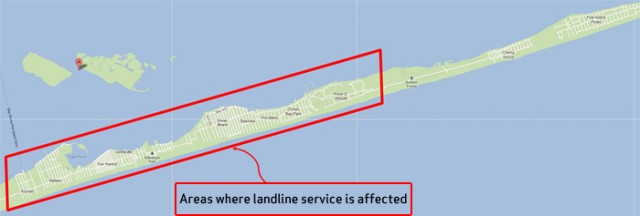
AG Opposes Verizon Push to Substitute Wireless for Copper Landline Telephone and DSL service

Citing damage on the western part of Fire Island from the Sandy storm in early November 2012, about six months later, on May 3, 2013, Verizon filed a new tariff with the New York Public Service Commission seeking permission on short notice to substitute wireless service for landline service, not only on Fire Island but elsewhere. See  Larry Rulison, Blame wireless talk on Sandy - Verizon steps up plan for new phone lines due to storm damage, Times Union, May 7, 2013 ("Superstorm Sandy may have hastened the demise of traditional land line telephones in New York state").

The filing, if approved by the PSC, could allow Verizon to substitute wireless service for landline in many areas of New York where Verizon has no intention of deploying FIOS and desires to terminate copper landline phone and DSL service, relegating its customers to cable providers, who would then enjoy a monopoly on wired service, or to wireless services, where Verizon is a dominant provider.   See  DSLReports.com :


The Verizon petition is opposed by the Communications Workers of America (CWA), the New York Attorney General, and PULP.

The matter is on the PSC agenda for May 16, 2013.

****************
Update

At its May 16, 2013 meeting, the PSC authorized substitution of wireless for wireline service as an interim measure on western Fire Island.  The Commission press release states, in part:

The New York State Public Service Commission (Commission) today, as an interim measure, authorized Verizon New York, Inc. to offer wireless Voice Link service, as an alternative to basic landline service, to certain customers on Fire Island where the copper wire facilities were destroyed by Superstorm Sandy. The Commission conditioned its temporary approval of the service, limited to western Fire Island, pending public comment and a further review of documentation submitted by Verizon justifying its decision not to repair the damaged facilities. Under the tariff provisions approved by the Commission, Verizon is required to offer the Voice Link service according to Commission rules and regulations for basic telephone service and would need to seek further approval to offer the service in other areas.
“The decision today is a novel, interim approach to an unusual set of circumstances resulting from Superstorm Sandy, urged on by the need to have telephone service in place by the summer,” said Commission Chairman Garry Brown. “The Commission will exercise its regulatory authority over this service to ensure consumers on Fire Island are protected with requirements relating to customer protection, customer complaints, service quality, safety and reliability, and we will continue to explore what are the best options for permanent repair.”
**** The Commission’s action today is not its final decision on this issue. As part of the ongoing proceeding, the Commission said it will seek comments from interested parties on Verizon’s technology and service plan as it works to determine a permanent solution. The Commission also directed Verizon to provide it with a comprehensive report evaluating the quality and reliability of Voice Link to Fire Island customers by November 1, 2013. 

Apparently, the substitution of wireless for wireline service is not the broader latitude sought by Verizon, but rather will be limited to "certain customers on Fire Island where the copper wire facilities were destroyed by Superstorm Sandy...."

**************
May 22, 2013
The PSC Order Conditionally Approving Tariff Amendments In Part, Revising In Part, and Directing Further Comments indicates the Commission will invite further comment on Verizon's request for permission to substitute fixed wireless "Voicelink" for landline service.

The wireless service will not support fax or DSL broadband service that customers may now receive on their landlines.  It has been likened to nailing a cellphone to the wall.  

With Verizon essentially trying to exit the landline market in some areas, consistent with its marketing pact with cable companies, customer choices will be reduced, and the logical step for many DSL customers if they lost landline service would be to shift to cable broadband or subscribe to higher cost wireless data service.  

On May 21, 2013 the Commission issued a Notice Inviting Comment in Case 13-C-0197.
The Commission described Voicelink as follows:

Although Voice Link service utilizes the same wireless technology as a cell phone, it is similar in many respects to traditional wireline service. It is designed for use with wireline premises equipment; it remains stationary at one location in the customer’s premises; and, it provides E911 service in the same manner as wired basic telephone service. A small device is installed at a customer’s premises; and, according to Verizon, the device provides superior reception of wireless signals in comparison to regular wireless service. The device is equipped with a battery back-up, in case of commercial power loss. According to Verizon, available devices are equipped with rechargeable battery packs, while newer units are expected to operate on standard AA batteries.
Voice Link Service
In several respects, Voice Link service is materially different compared to traditional wireline services. It is not compatible with fax machines, medical alert and home security monitoring systems, credit card machines and, Digital Subscriber Line (DSL) technology. Voice Link service requires use of mandatory 10 digit dialing, rather than 7 digits, which is the Commission-approved dialing pattern for calls within many area codes, including the 631 area code. It is not equipped to transmit: calls to certain specialized area codes, such as 900; certain central office codes, such as 976 or 950; collect, or reverse charge, calls; or calls to an operator by dialing 0.

The notice invites public comments on these matters by June 18, 2013:
the issues presented include: use of Voice Link in western Fire Island, its use in other geographic areas with destroyed wireline facilities, and its use in areas based upon geographic location, availability of alternative telecommunications providers, or other Commission designated criteria.

Persons interested in obtaining Verizon’s submission and tariff amendment and any other documents filed in the case may view them at http://www.dps.ny.gov. From the Department of Public Service’s homepage, click on Commission Documents, Search by Case Number and enter 13-C-0197. If you are unable to access the documents electronically, you may contact the File Room at (518) 474-2500.
Persons wishing to comment on these matters may do so by June 18, 2013 by: e-filing through the Department’s Document and Matter Management System (DMM), secretary@dps.ny.gov e-mailing the Secretary to the Commission at ; postal mail or hand delivery to Jeffrey C. Cohen, Acting Secretary, New York State Public Service Commission, Three Empire State Plaza, Albany, New York 12223-1350; calling the toll-free Opinion Line at 1-800-335-2120, set up to receive in-state calls 24-hours a day, by pressing 1 for the main menu and 2 to leave comments, mentioning Voice Link or Case 13-C-0197. All comments submitted are entered into the official case record and reported to the Commission for its consideration. Any person may access them at the Department’s Web site http://www.dps.ny.gov by searching 13-C-0197.

The simplest way to comment is to go to the online PSC case file for Case 13-C-0197 and use the "Post Comment" button. One can also view the papers filed and public comments on the case.


*****************

Friday, May 03, 2013

Administrative Judges Issue Recommended Decision Advising PSC to Reject Central Hudson/Fortis Merger

Two Administrative Law Judges of the New York State Department of Public Service Issued a Recommended Decision on May 3, 2013 advising the Public Service Commission to reject the proposal of Central Hudson Gas & Electric Company to be acquired by Fortis, Inc., a Canadian company.  The Judges concluded:

We find it relatively easy to conclude that the benefits of the merger transaction pursuant to the Joint Proposal are outweighed by the detriments remaining after mitigation. Our rationale is that the proposed transaction has generated an extraordinarily intense degree of public opposition to a change of Central Hudson’s ownership among customers, their elected officials, and labor representatives and other public organizations in the service territory. 
The Judges allowed for the possibility that the terms of the merger proposal might be improved through modification, but expressed skepticism that would be feasible.

Under the PSC decisional process, parties have the opportunity to file briefs on exceptions challenging findings or conclusions of the judges, and reply briefs to objections lodged by other parties.  Initial briefs are due May 17, and reply briefs are due May 24.


*****************


Monday, April 29, 2013

N. Carolina Supreme Court Reverses State PSC Approval of Duke Power Electric Rate Settlement Finding Insufficient Review of 10.5% Profit and Customer Impact


The North Carolina Supreme Court on April 12, 2013 issued an opinion nullifying a Duke Power rate settlement approved by that state's Public Service Commission (PSC).  Duke Power in its initial rate case filing had asked for an increase of $646,057,000, to cover anticipated future costs of operation and maintenance and an profit allowance of 11.5%, representing an allowed return on investors' equity (ROE).  The PSC's Public Staff expert witness testified that the ROE should be 9.25%.  A non unanimous settlement agreement was eventually reached between the utility and the PSC's Public Staff for a rate increase of $309,033,000 -- less than half what the utility asked for, but still an annual rate increase of 7.21% faced by consumers.  The settlement amount was based in part on an agreed-upon ROE (profit) of 10.5%.  The estimated difference between the recommended ROE of 9.25% and the agreed-upon ROE of 10.5% in the settlement was approximately $100,000,000.

In its opinion, a resounding victory for consumers, the Court reversed the PSC order approving the settlement deal, and remanded the case to the PSC for further proceedings.  The Court faulted the PSC approval of the settlement because it lacked any independent determination of ROE when not all parties had settled the issue: 
Without sufficient findings of fact as to these issues, we cannot say that the Commission ―ma[de] ‗its own independent conclusion‘ . . . that the propos[ed] [ROE] [wa]s just and reasonable to all parties in light of all the evidence presented.* * * *  Instead, it appears that ―the Commission adopted wholesale, without analysis or deduction, the 10.5% stipulated ROE, ―as opposed to considering it as one piece of evidence to be weighed in making an otherwise independent determination.* * * *  Accordingly, the Commission‘s order must be reversed and this case remanded to the Commission so that it can make an independent determination regarding the proper ROE based upon appropriate findings of fact that balance all the available evidence.
In addition, the Court chastened the Commission in its focus on investor interests in setting the ROE. Citing the North Carolina statutes, the Court made clear that there must be consideration not only of investor interests, but also the impact of changing economic conditions on customers:
Given the legislature‘s goal of balancing customer and investor interests, the customer-focused purpose of Chapter 62, and this Court‘s recognition that the Commission must consider all evidence presented by interested parties, which necessarily includes customers, it is apparent that customer interests cannot be measured only indirectly or treated as mere afterthoughts and that Chapter 62‘s ROE provisions cannot be read in isolation as only protecting public utilities and their shareholders. Instead, it is clear that the Commission must take customer interests into account when making an ROE determination. Therefore, we hold that in retail electric service rate cases the Commission must make findings of fact regarding the impact of changing economic conditions on customers when determining the proper ROE for a public utility.
The North Carolina Attorney General's Utilities Section participated as an active party in the case.  The office, which is empowered to seek judicial review of the state PSC's decisions, is an independent utility consumer advocate and member of NASUCA, The AARP Foundation filed a brief amicus curiae with the North Carolina Supreme Court urging the Court to reverse the PSC order that had approved the rate case settlement.


*****************

Friday, April 19, 2013

PSC Begins Proceeding to Review and Possibly Reduce National Fuel's Natural Gas Rates, based on Estimate of 13.15% ROE Under Current Rates

The PSC has issued an order to show cause commencing a rate review proceeding to review reasonableness of the rates, terms and conditions of service of National Fuel, which serves  natural gas customers in the Buffalo area.  The Commission order indicates the possibility that the rates, last set by PSC order in 2007, are now too high and that they may be lowered:

In the 2007 Rate Order, the rates set for National Fuel were expected, among other things, to permit National Fuel to earn a return on equity (ROE) of 9.10% for the rate year ended December 31, 2008 based on a 44.35% common equity ratio. Under the 2007 Rate Order, there is no ROE earnings sharing mechanism, and, therefore, National Fuel retains all excess earnings when they occur. The rates and other terms prescribed in the 2007 Rate Order remain in effect today.  A review of the Company’s more recent financial statements by Department of Public Service Staff (Staff) indicates that National Fuel may now be earning in excess of the 9.10% ROE envisioned by the 2007 Rate Order, and in excess of a reasonable return. Staff’s projection forward suggests that this condition may continue in the future.
Specifically, National Fuel measures its annual earnings on a fiscal year basis that ends September 30th. The latest earnings calculation provided by the Company based on a 50% equity ratio, for the twelve months ended September 30, 2012, showed an earned unadjusted ROE of 12.77%. National Fuel made normalizing adjustments that appear to reduce the ROE to 11.87%. However, after adjusting the Company’s calculation for the 44.35% equity ratio allowed in its current rates and removing executive restricted stock and stock option compensation expense not allowed in current rates, Staff calculates that National Fuel earned a 13.15% equity return for the twelve months ended September 30, 2012.
A copy of the Order to Show Cause is here.   The proceeding will take about a year. If current rates are reset as temporary rates, potential refunds could be made retroactive to the date when temporary rates are set, if rates are eventually lowered at the conclusion of the case.

In March, National Fuel floated a proposal to keep in place its current rates and share any overearnings over a threshold (calculated generously high for the utililty) with customers, with the customer share of overearnings allocated to certain purposes other than reducing rates.   Also the proposal would reallocate certain unspent funds to the utility's low income customer assistance program to offset sharp reductions in LIHEAP assistance.  Apparently the utility anticipated it would be called in for a rate review, and sought to forestall rate case litigation with some concessions that were insufficient.

The PSC webpage for the case, which will contain documents from the case, is here.

In a rate review proceeding, the utility has the burden to show that its rates, terms and conditions of service are just and reasonable. Customers and the general public can make their views known to the PSC regarding the rates, terms and conditions of service and practices of the utility by filing their comments here.


*****************


PSC Warns Landlords to Follow Submetering Orders Allowing Sale of Electric Service to Residential Tenants


Landlord submetering of utility service to residential customers can rob end users of their consumer sovereignty by controlling the energy sources they need to sustain themselves.  Historically, in response to landlord abuses in tying their tenants to landlord designated suppliers of essential services, the legislature prohibited landlords from requiring tenants to buy fuel, ice or food exclusively through the landlord or his designated suppliers.    Submetering of electricity to residential tenants, however, was not subject to the ban against tied fuel services, and was allowed in the first half of the twentieth century. This led to overcharges, rampant abuses and chronic problems for tenants which surfaced prominently in the 1920's, 1930's, and 1940's.   
These problems culminated in the PSC’s eventual prohibition of submetering to residential tenants in 1951.   The courts upheld that ban in Campo v. Feinberg.   

The PSC, however, in the 1970’s revisited the issue out of environmental concern that tenant users were not directly financially responsible for electric usage.  Over the opposition of its staff, which preferred direct utility metering and predicted the recurrence of chronic landlord tenant disputes at the PSC over submetered electric service charges, the Commission  allowed landlords to petition for relaxation of its submetering ban, on a building by building basis. 

Commission regulations on the subject mainly prescribe the content of landlord petitions to waive the ban on submetering.  They impose few substantive requirements, other than a requirement that owners not charge more than the utility would charge a direct metered customer (the "rate cap").   In 2002, the Home Energy Fair Practices Act was amended to clarify that all electric service to residential customers, whether provided by traditional utilities, ESCOs, or by submetering landlords, must be provided in accordance with the consumer protections and complaint adjudication procedures of HEFPA.

In a recent  PSC decision resolving the complaint of the Hazel Towers Tenants Association, in which the landlord had failed to comply fully with a 2001 Submetering Order, the PSC sent a clear warning to submetering landlords that they may incur civil liability for HEFPA violations or for failing to adhere to promises in their petitions, in the form of stiff penalties.  The Hazel Towers ruling emphasizes that landlords who have overcharged who then provide a retroactive refund to tenants for any improper billings will not necessarily avoid liability:
Notwithstanding that tenants have been, or will be, provided with refunds to which the record before us shows them to be entitled, the owner’s failure to comply properly and in a timely manner with the 2001 Submetering Order is a serious matter. Such failure, like the failure to timely comply with any provision of a submetering order, could subject the submeterer to a penalty pursuant to PSL §25.
The PSC explains that landlords carry the burden to accurately assess the rate cap, which bars any charges which are more than what the utility would charge its direct service residential customer for the same usage:
an owner is required to ascertain the rate cap correctly for each residential occupant’s bill and to properly reduce the occasional bill, whenever there is one, that exceeds the correctly-calculated rate cap.
The rate cap is an essential component of the submetering regime, which may thwart the tenant's normal right to service upon demand from the utility: if the submetering rate cap is observed, claims of economic injury from landlord-provided service are avoided.  The PSC further stated that landlords have an affirmative duty to work with the utility in verifying that tenants are not being charged any more than they would if they had been directly billed by the utility:
However, a submetered customer is entitled to no less than an electric bill calculated with the same accuracy as would be provided had the occupant been directly metered by Con Edison. Moreover, these failures indicate a problem that should be addressed in the first instance by submeterers and by Con Edison.
In earlier phases of the PSC complaint proceeding, refunds of over $35,000 were made to the complaining tenants.  In the final decision, the PSC found additional, small overcharges had not been corrected.  The decision stressed that even seemingly small or innocuous violations can subject the landlord to strict civil liability.
This owner and other submeterers, should be aware that, in the future, even a violation of a submetering order which causes no financial harm or penalty to tenants or which is based on a failure to timely comply and is subsequently addressed by a later, untimely action, may, in appropriate circumstances, be the basis of a penalty action against the submeterer pursuant to PSL §25.

Pursuant to PSL §25 landlords knowingly failing to or neglecting to obey or comply with the rules and regulations or orders of the Public Service Commission may result in fines up to $100,000. The fines increase to up to $250,000 when human safety is compromised and jumps to $500,000 if the overall reliability and continuity of electric service is constrained. In the case of a continuing violation, each day shall be deemed a separate and distinct offense, thus massive fines can accrue quickly.

Landlords engaging in submetering should as a precaution be very mindful of the PSPC requirements in the orders and regulations, take all necessary steps to comply with them, and to work with the utility company to ensure that price caps are being adhered to before billing tenants.  PULP has urged the PSC to require utilities to provide bill calculators on their websites, so that submetered tenants could compare the bills they receive from landlords with what the utility would charge for the same usage in the same period of time.

Major submetering problem areas remain.  For example, landlords often do not provide personal service of their petitions upon tenants of the pendency of the PSC proceeding in which their leases will be affected, so most orders are issued without any tenant participation.   DHCR rent reduction guidelines give smaller rent reductions to tenants when an owner is allowed to convert from master metering to submetering, compared with the reductions when a conversion is to direct utility metering.  This discrepancy is based on DHCR's questionable methodology which assumes that the bulk rates for the master metered service are 20% less than utility rates for individual direct service to residential customers.  Subsequent changes in electric rates since the DHCR methodology was adopted may have rendered obsolete the assumption that submetering bills are always significantly lower than direct service.  Also, since there is no routine outside audit of landlord charges, when bulk metering charges are less than what the utility would charge its residential customers, there is no way for tenants to know whether instead of passing through the bulk metering costs (plus a $4 billing charge) without profit or markup, as PSC orders require, a landlord is marking up costs while staying under the maximum rate, which in theory can be independently checked by comparison with Con Edison charges.  The DHCR rent reduction methodology also assumed, without independent research to back it, that customers use 20% less electricity after conversion to metering. More realistic assumptions are in the area of 0 to 7%. As a consequence, landlords do not need to reduce the rent as much and receive a windfall when they shift responsibility for electric bills to tenants.

*****************